
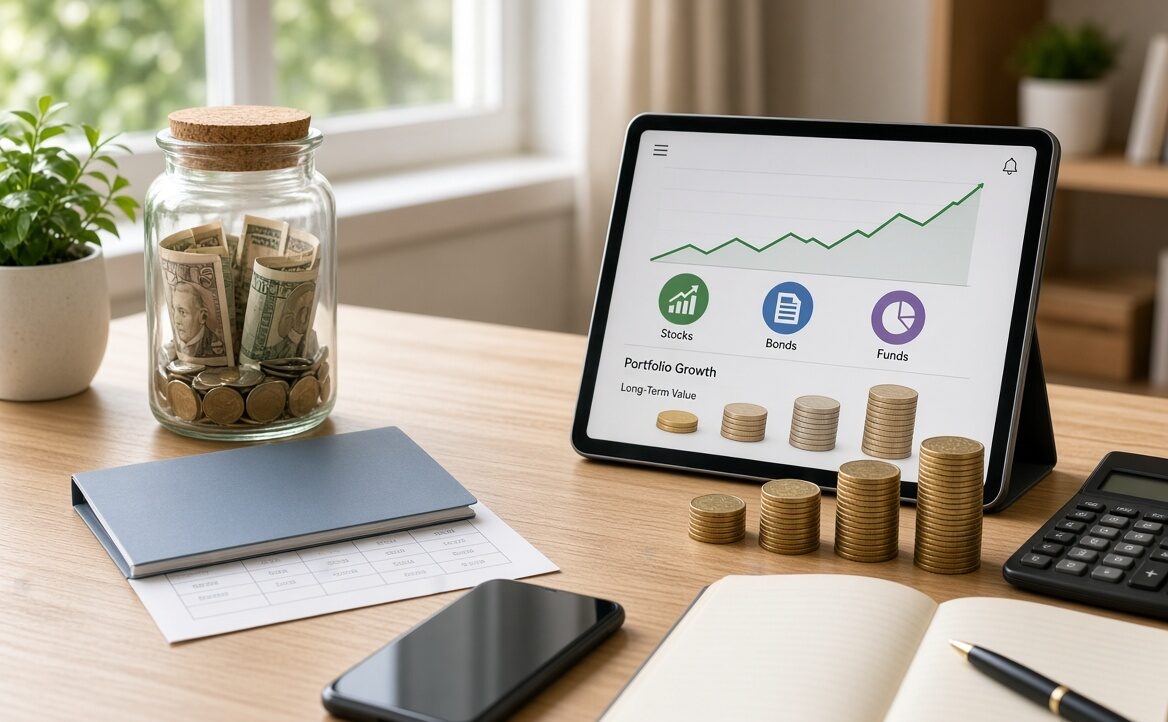
People throw “saving” and “investing” around like they mean the same thing, and it bugs me a little because they really don’t — different purpose, different risk, different job in your financial life. You need both. But you make better decisions once you actually understand what separates them.
What Is the Difference Between Saving and Investing?
The core difference
Saving means parking money somewhere safe and accessible. You’re not trying to grow it much, just keep it stable and available.
Investing means putting money to work expecting it to grow, and accepting that its value can dip before it climbs — sometimes it can drop a lot.
Simplest way to put it: savings is money you might need soon. Investments are money you won’t touch for years.
What saving actually looks like
High-yield savings accounts, usually through online banks, currently sit around 4-5% APY (this moves with the Fed rate). FDIC insured up to $250,000, so your money’s protected even if the bank goes under.
Money market accounts are similar, sometimes with check-writing or a debit card attached. Also FDIC insured.
CDs lock your money for a set term — three months up to five years — for a fixed rate. Better return than a regular savings account, but you’re penalized for touching it early.
Checking account cash isn’t really “saving” in any productive sense since it earns basically nothing, but it’s where your spending money lives.
The thing all of these share: your $1,000 stays $1,000, maybe grows a little with interest. You won’t wake up one day and find it’s $700 because the market had a bad week.
What investing actually looks like
Stocks are ownership stakes in a company — value goes up when the company does well, down when it doesn’t. Individual stocks can be genuinely volatile, sometimes down 40% in a bad year.
Index funds spread your money across hundreds or thousands of companies instead of betting on one. An S&P 500 fund tracks the 500 largest US companies and has historically averaged around 10% annual returns over long stretches — this is basically the default recommendation from most financial advisors.
ETFs work similarly but trade throughout the day like a stock.
Bonds are essentially loans to a government or company, paid back with interest — lower risk than stocks, lower reward too.
Real estate needs more capital and hands-on involvement, and comes with its own headaches (vacancies, repairs, downturns).
401(k)s and IRAs aren’t investments themselves — they’re tax-advantaged containers that hold your investments.
The core thing to internalize: value moves. A $10,000 portfolio could be $8,000 after a rough quarter. Normal. Over ten, twenty, thirty years, diversified portfolios have historically grown a lot despite short-term dips — but only if you can ride those dips out without needing the cash.
When to save, when to invest
Need it within 1-3 years? Save. Emergency fund, a house down payment coming up soon, a car — you can’t have that money down 20% right when you need it.
Won’t touch it for 5+ years? Invest. Retirement, long-term wealth building. Time is what lets you survive the dips and actually capture the growth.
Why five years specifically — markets can take two to four years to bounce back from a real downturn. Invest money you need in two years, get hit by a recession, and you might be forced to sell at a loss. Give it ten years and that same downturn is just a temporary dip you shrug off.
Putting numbers to it
$5,000 in a high-yield savings account at 4.5%, left alone for 20 years, comes out to roughly $12,100.
Same $5,000 in an index fund, averaging around 7% annually after inflation, comes out to roughly $19,300 over the same 20 years.
Same starting amount, same timeframe — over $7,000 apart. Add regular contributions and stretch the timeline further and that gap gets a lot bigger. That’s compound growth, and it’s why starting early matters so much for retirement.
A rough order to do things in
- Build a small starter emergency fund, at least $1,000 — savings
- Contribute enough to your 401(k) to get the full employer match — basically a guaranteed 50-100% return
- Knock out high-interest debt (anything above 7-8%)
- Build your full emergency fund, 3-6 months of expenses — savings
- Max your Roth IRA if you’re eligible
- Bump up 401(k) contributions further
- Taxable brokerage accounts once retirement accounts are maxed
This order isn’t arbitrary — it front-loads the guaranteed wins (killing high-interest debt, capturing the match) before you move to returns that depend on the market.
The mistake people make: “savings feels safer”
I get it, the market feels scary, especially with headlines about crashes. But here’s the catch — inflation runs roughly 3-4% historically. If your savings account earns 2% while inflation runs 3%, you’re technically losing purchasing power even while the number on the screen goes up. More dollars, less they can actually buy.
For long-term money, “safe” savings carries its own hidden risk: it just won’t grow fast enough to outpace rising costs.
Investing doesn’t feel safe because the balance swings around. But for money you’re not touching for a decade or more, it’s statistically been the right move.
Bottom line
Save your emergency fund and anything you need soon. Invest for retirement and anything ten-plus years out. They’re not competing against each other — they’re doing different jobs.
If you’re not investing for retirement yet, start now, even if it’s $50 a month into a Roth IRA in a plain index fund. That beats waiting until you “feel ready.” Time is the one variable you genuinely can’t get back once it’s gone.
Conclusion
In conclusion, saving and investing both play important roles in building financial security, but they serve different purposes. Saving is generally focused on keeping money safe and accessible for short-term needs and emergencies, while investing aims to grow money over the long term, with greater risk. Understanding the difference can help you choose the right approach based on your financial goals, timeline, and comfort with risk.
Can I save and invest at the same time?
Yes. Many people maintain savings for short-term needs while investing separately for long-term financial goals such as retirement or wealth building.
Is investing riskier than saving?
Generally, yes. Investments can lose value, while money held in a savings account is typically more stable, although its purchasing power can be affected by inflation.
Is saving or investing better?
Neither is always better. Saving is useful for emergencies and short-term goals, while investing may be more suitable for long-term goals.
What is the main difference between saving and investing?
Saving focuses on keeping money safe and accessible, while investing involves putting money into assets with the goal of growing it over time.
Should I save money before I start investing?
It is often wise to build an emergency fund and handle high-interest debt before investing significant amounts. This can provide financial stability when unexpected expenses arise.