
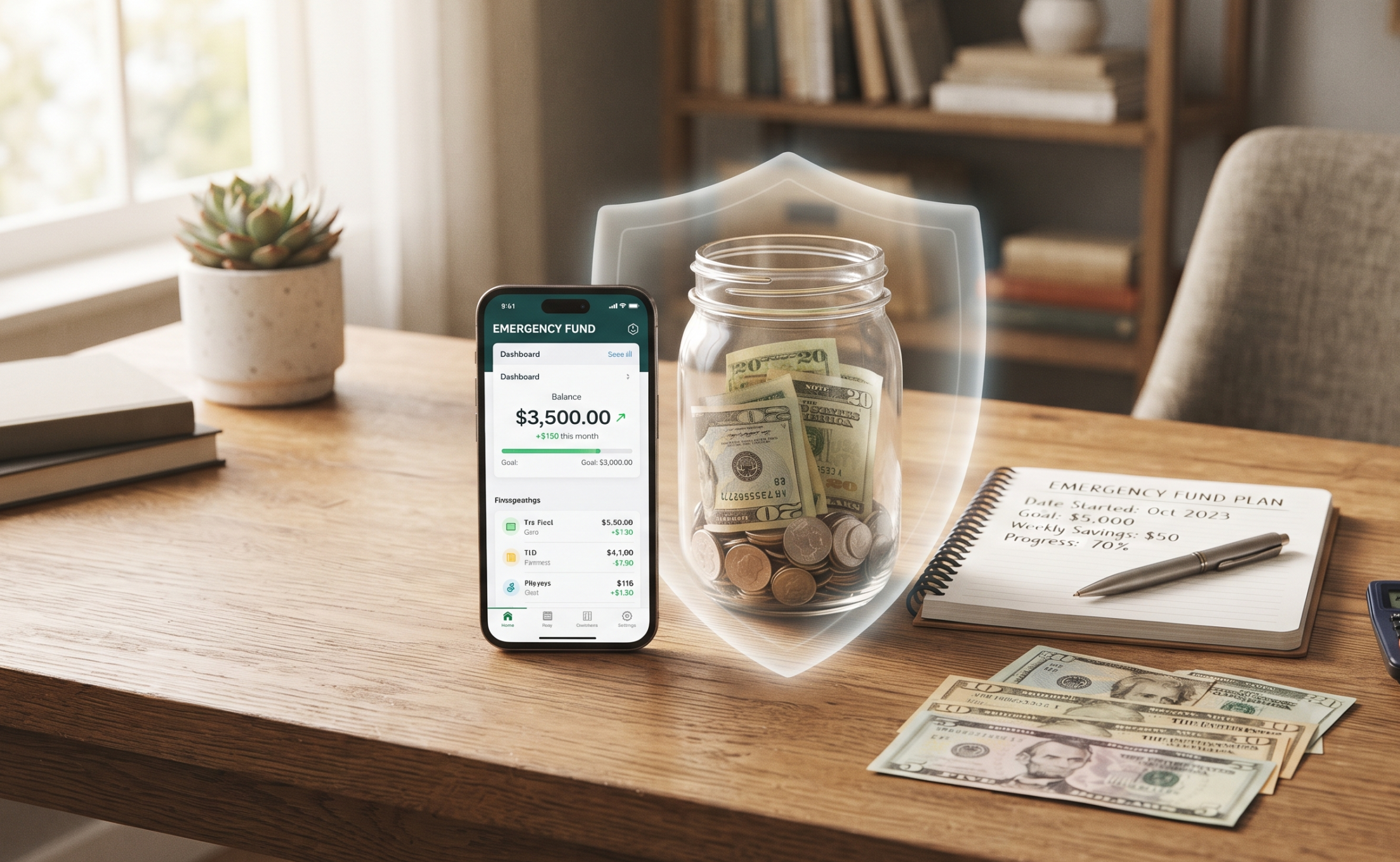
My car broke down on a Tuesday morning. The repair was $847. I had $212 in my checking account.
That was the moment I understood, viscerally, what it meant not to have an emergency fund. I had to call my mom. I was 27. It was humiliating and stressful and completely avoidable if I’d been putting away even $50 a month for the previous year.
How Do I Start an Emergency Fund?
If you don’t have an emergency fund yet, here’s how to actually build one — even when money is tight.
What an Emergency Fund Is (And What It Isn’t)
An emergency fund is money set aside specifically for unexpected, necessary expenses. Car breaks down. Sudden medical bill. You lose your job. Water heater dies.
It is not:
- Money for planned purchases (“I’m saving up for a vacation”)
- A rainy day fund for impulse spending
- Your retirement savings
- Money you dip into when you’re just a little short at the end of the month
The whole point is that it stays completely separate from your regular spending, earns a little interest while it sits there, and is only touched when something genuinely unexpected and necessary happens. When you use it, you immediately start rebuilding it.
Step One: Start Smaller Than You Think
The most common advice is to save three to six months of expenses. That’s the right long-term goal. But if you’re starting from zero with a tight budget, “save $10,000” is so daunting that it makes people do nothing.
Start with $1,000. Just $1,000. That number is meaningful because it covers most common emergencies — a car repair, an ER copay, a sudden home appliance failure. It’s not full protection, but it breaks the paycheck-to-paycheck cycle on a lot of common disasters.
Once you hit $1,000, you’re no longer starting from zero. Then you work toward one month of expenses. Then three. Then six. But the goal right now, if you have nothing saved, is to get to $1,000.
Step Two: Open a Separate Account
This sounds like a small thing but it’s psychologically critical: your emergency fund has to be in a different account from the money you use for everyday spending.
If it’s in the same checking account, it doesn’t feel like emergency money. It feels like your balance. You spend it slowly without realizing it.
Open a high-yield savings account at an online bank. As of the time I’m writing this, rates at places like Marcus by Goldman Sachs, Ally Bank, American Express High Yield Savings, and Discover Savings are significantly better than what traditional brick-and-mortar banks offer on savings. We’re talking 4-5% APY versus 0.01% at a big bank. The interest compounds, and on $5,000 that’s real money.
Online savings accounts are also slightly less convenient to access, which is actually a feature. The small friction of transferring money before you can spend it gives you a moment to pause and ask if this is actually an emergency.
Step Three: Find Your Starting Amount
Look at your current budget (or your bank statements if you don’t have a formal budget) and find something to cut, however small.
I know “just cut expenses” is advice that can feel condescending when you’re truly stretched thin. So I’ll be specific about what I mean: you’re not looking for a big dramatic cut. You’re looking for $25 or $50 a month to start. That’s it.
Some places to find it:
Subscription audit. Go through your bank statement and highlight every recurring charge. Most people find at least one or two subscriptions they forgot about or don’t really use. Cancel those.
One food swap per week. If you eat out or order delivery twice a week, cut it to once. The difference might be $30-$50 a month.
Sell something. Clothes you don’t wear, electronics you’re not using, furniture you’ve been meaning to list. Put whatever you get straight into the emergency fund.
Round-up apps. Apps like Acorns or Chime’s round-up feature automatically round up purchases to the next dollar and save the difference. It’s tiny amounts individually, but adds up without hurting.
Step Four: Automate the Transfer
The single most effective thing you can do: set up an automatic transfer from your checking to your emergency fund savings on the same day your paycheck hits.
Even $50 a month. Even $25. Doesn’t matter. The automation is the thing.
Humans are bad at saving “what’s left over” because there’s usually nothing left over. We spend until things are gone. Automation flips the order — you save first, then spend what remains.
Set the transfer for the day after payday. Or the same day. Whatever works. But make it automatic so it happens whether you remember and feel motivated or not.
Step Five: Put Windfalls Directly In
Any time money comes in outside your normal income — a tax refund, birthday cash, a bonus at work, money from selling something, freelance income — a chunk of it goes straight to the emergency fund.
You don’t have to put all of it in. Let yourself celebrate. But even putting half of an unexpected $500 into savings ($250) can meaningfully accelerate how fast you build the fund.
Tax refunds are a big one. The average US tax refund is around $2,000-$3,000. If you have no emergency fund and you’re getting a refund, the single best thing you can do with a significant portion of that money is park it in a high-yield savings account as your emergency fund foundation.
What If Things Are Really Tight?
If your income barely covers your necessities and you genuinely have nothing to cut, the conversation has to shift from “save more” to “earn more” — at least temporarily.
Some realistic options people actually use:
- Overtime at your current job if available
- One-off gig work (TaskRabbit, dog walking, odd jobs on Craigslist)
- Selling things you own
- A side hustle matched to skills you already have (tutoring, handyperson work, food delivery)
Even an extra $200 one month from a side hustle, directed straight to the emergency fund, matters. The goal is momentum.
Common Questions
Can I use a credit card as my emergency fund instead?
Technically it works in the short term, but I’d push back. Credit cards charge interest — if you can’t pay off the emergency charge immediately, you’ve traded a $500 problem for a $500 + ongoing interest problem. An actual cash emergency fund doesn’t cost you anything to use.
Should I pay off debt or build an emergency fund first?
Both, in a specific order: get to $1,000 in the emergency fund first, even if you have debt. Then attack the debt aggressively. Then build the full 3-6 month fund. Without that initial $1,000, any unexpected expense forces you back into debt anyway.
Where exactly should I keep it?
High-yield savings account at an online bank, as I mentioned above. Not under your mattress, not in an investment account (too much volatility and too hard to access quickly), and not in your regular checking account.
A Quick-Start Plan
Week 1: Open a high-yield savings account (takes about 10 minutes online). Transfer whatever small amount you can right now — even $10.
Week 2: Set up an automatic monthly transfer of whatever you can manage. Adjust your budget to find the money.
This month: Do a subscription audit. Cancel anything you don’t actively use.
If you get a windfall: Put at least 50% of it straight into the fund.
First milestone: $1,000. Celebrate when you hit it.
Long-term goal: 3-6 months of essential expenses.
The $847 car repair that broke me at 27 would cost me almost nothing today. Not because I make dramatically more money — but because I have an emergency fund that covers it. That security is real and it’s available to basically anyone who starts the habit. It just has to actually start.
Conclusion
In conclusion, starting an emergency fund does not require a large amount of money. Begin by setting a realistic savings goal, creating a budget, and making regular contributions to a separate, easily accessible savings account. Even small amounts can add up over time and provide valuable financial protection when unexpected expenses arise.
How much should I save in an emergency fund?
A common goal is to save enough to cover 3 to 6 months of essential living expenses. Start with a smaller target if that feels more manageable.
Where should I keep my emergency fund?
Keep it in a safe and easily accessible savings account so you can use the money quickly when an unexpected expense occurs.
How can I build an emergency fund with a small income?
Start by saving a small amount regularly, even if it is only a few hundred rupees each month. Review your budget and redirect unnecessary spending toward your savings.
How often should I contribute to my emergency fund?
Try to contribute consistently, such as after every paycheck or once a month. Automating your savings can make it easier to stay consistent.
When should I use my emergency fund?
Use it for genuine unexpected expenses, such as urgent repairs, medical costs, or a sudden loss of income. Avoid using it for planned or non-essential purchases.