
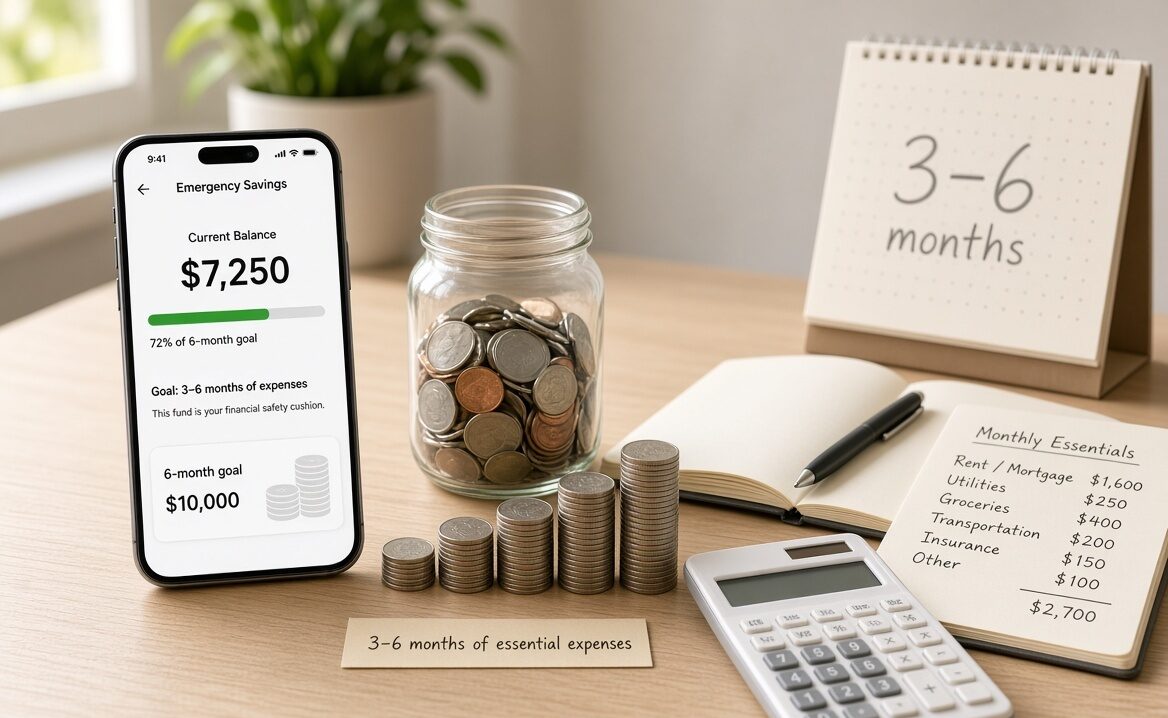
“Three to six months of expenses.”
You’ve probably heard that. It’s everywhere. It’s also kind of frustratingly vague, because the difference between three months and six months can be $5,000 or more depending on your situation. And what exactly counts as “expenses” anyway?
How Much Should Your Emergency Fund Be?
Let me actually break this down so you end up with a number that makes sense for your life specifically.
Why the Range Exists
The three-to-six-month range isn’t arbitrary — it reflects the fact that different people face different levels of financial risk, and therefore need different cushions.
The core purpose of an emergency fund is to cover essential living costs if your income stops or drops suddenly, and to handle unexpected expenses without going into debt or financial crisis.
How much cushion you need depends on:
- How stable your income is
- Whether you have other income sources if yours stopped
- How hard it would be to find a new job if you lost yours
- How many people depend on your income
- What kind of unexpected expenses are most likely in your life
The Two Types of Expenses to Include
Before you calculate a number, you need to define “expenses.” For emergency fund purposes, we’re talking about essential expenses only — not your full current budget.
Essential expenses include:
- Rent or mortgage
- Utilities (electricity, water, gas, internet)
- Groceries (basic food, not restaurant spending)
- Minimum debt payments (car loan, student loans, credit card minimums)
- Insurance premiums
- Transportation to work (gas, transit pass)
- Essential medications and healthcare
Not included in your emergency fund calculation:
- Dining out
- Entertainment and subscriptions
- Shopping
- Vacations
- Gym memberships
The idea is: if your income stopped today, what would you absolutely have to pay to keep a roof over your head, food on the table, and your credit in decent shape? That’s your monthly essential expenses number.
For many people this number is significantly lower than what they actually spend each month. Someone spending $4,000 a month might find their essentials are only $2,500.
Who Needs Three Months (or Less)
You’re on the lower end of the range if:
Your income is stable and predictable. Salaried employees with long tenure at stable companies, government workers, teachers, healthcare professionals — jobs where layoffs are uncommon and severance packages are the norm.
You have a dual-income household. If you and a partner both work, the odds that you both lose income simultaneously are much lower. One income could carry essential expenses for a period while the other is being replaced.
You have other financial backstops. Significant accessible savings elsewhere, family you could realistically turn to in an emergency, or assets you could liquidate without major loss.
Your field has strong job demand. Software engineers, medical professionals, skilled tradespeople — fields where finding a new position typically takes weeks, not months.
You have relatively predictable expenses. No home ownership (so no major repair risks), newer car (less likely to break down unexpectedly), good health.
If this sounds like you, three months of essential expenses is probably appropriate.
Who Needs Six Months (or More)
You’re on the higher end of the range if:
Your income is variable or irregular. Freelancers, commission-based sales, self-employed people, gig workers, seasonal employees — anyone whose income can swing significantly month to month needs more cushion because the variability itself is a source of risk.
You have a single-income household. One income supporting the household means one job loss is a complete financial shutdown. More cushion is necessary.
You’re in a specialized or competitive field. If job searching in your industry typically takes three to six months, then three months of savings means you’re running out of money right when you might be getting offers. You need enough to cover the realistic job search timeline.
You’re a homeowner. Homes come with unexpected large expenses — HVAC systems, roofs, plumbing — that aren’t as much of a risk in a rental. Six months gives you more ability to handle both income disruption and a major home repair simultaneously.
You have health issues or dependents with health needs. Medical costs can be sudden and significant. More cushion protects against this.
Your industry is volatile or sensitive to economic cycles. Tech layoffs, real estate market downturns, media industry consolidation — some fields have significant boom-bust patterns. People in volatile sectors should lean toward six months.
What a Real Number Looks Like
Let me walk through two examples:
Example 1: Single teacher, renting
- Monthly essential expenses: $2,200 (rent $1,200, groceries $300, utilities $150, transportation $200, phone $100, loan minimums $250)
- Job stability: High (tenured, government-backed pension system)
- Single income: Yes
- Recommendation: 4 months = $8,800
Example 2: Freelance graphic designer, homeowner, married
- Monthly essential expenses: $3,800 (mortgage $1,800, utilities $250, groceries $500, transportation $300, insurance $450, phone $120, minimums $380)
- Income stability: Low (freelance, clients come and go)
- Household: Two incomes but partner also freelances
- Homeowner: Yes
- Recommendation: 6 months = $22,800
The same “3-6 months” advice gives dramatically different numbers based on circumstances. That’s why doing the actual calculation for your specific situation matters.
The Starter Goal vs. The Full Goal
If you’re starting from zero, the full three-to-six months number might feel impossible. That’s okay — work toward it in stages.
Stage 1: $1,000. This covers the most common emergencies — a car repair, a medical copay, an appliance that dies. It’s not enough for income disruption but it breaks the paycheck-to-paycheck cycle on unexpected expenses. Get here first.
Stage 2: One month of essential expenses. A meaningful buffer. A month of cushion buys you time to solve problems without panic.
Stage 3: Your full target (3-6 months). This is the full protection level. You can lose your job or face a major unexpected expense and have time to respond deliberately instead of desperately.
There’s no shame in being at Stage 1 for a while. Something is infinitely better than nothing.
What to Do With It Once You Have It
Keep it in a high-yield savings account at an online bank — separate from your checking account. Do not invest it in stocks or mutual funds.
Why not invest it for better returns? Because if the market crashes at the same time you need the money (they often happen together — economic downturns cause both job losses and market drops), you’d be forced to sell at a loss to access the funds. Your emergency fund needs to be stable, not growing-but-volatile.
Current high-yield savings rates are meaningful — 4-5% APY at many online banks. So your money is earning something while it sits there. That’s as good as it needs to be for this purpose.
Signs Your Emergency Fund Is the Right Size
You know you’ve hit the right number when:
- You can imagine losing your job tomorrow and feeling stressed but not panicked
- A $1,500 unexpected bill would be annoying, not catastrophic
- You’re not mentally counting on the emergency fund to cover anything predictable
- You can take the “right” job rather than the “first available” job because you have time
That feeling of financial breathing room — that’s what you’re buying. It’s not a number for its own sake. It’s a foundation that lets you make better decisions everywhere else in your life.
One More Thing
Once you have the fund built, the job isn’t over. Revisit the number annually. If your expenses increase significantly (you buy a house, have a child, take on more debt), your target number goes up. If your situation becomes more stable (dual income, more job security, employer disability insurance), you might recalculate down.
And when you use the fund — because eventually you will — rebuilding it becomes the top financial priority until it’s back to target. That’s not a punishment, it’s just the maintenance the fund requires.
The whole system works because the fund is always there, always refilling. It’s a permanent fixture of your financial life, not a one-time achievement.
Conclusion
In conclusion, the right emergency fund depends on your income, monthly expenses, job stability, and personal circumstances. A common goal is to save enough to cover 3 to 6 months of essential living expenses. Start with a manageable amount and build your savings gradually until you reach a comfortable financial cushion. Having an emergency fund can help you handle unexpected expenses without relying heavily on debt.
How much should I have in an emergency fund?
A common guideline is to save 3 to 6 months of essential living expenses. Your ideal amount may vary depending on your income, job stability, and
Is a 3-month emergency fund enough?
It can be a reasonable starting point, particularly if your income is stable and your expenses are predictable. You can gradually work toward a larger cushion
Should I include all expenses when calculating my emergency fund?
Focus on essential expenses such as housing, food, utilities, transportation, insurance, and minimum debt payments rather than optional spending.
Where should I keep my emergency fund?
Keep it somewhere safe and easily accessible, such as a savings account, so you can access the money quickly when an unexpected expense occurs.
What if I cannot afford to save 3 to 6 months of expenses yet?
Start with a small, realistic target and contribute regularly. Even a modest emergency fund can provide some protection while you work toward a larger savings goal.